
Choosing a good brush is very important, as a bad brush can make your spotting job impossible. Look for a good watercolor brush with natural fiber. The nylon and synthetic fibers just don’t seem to give you the control you need. My favorite brushes are Winsor and Newton, Series 7, made from Kolinsky Sable. Even when I’m shopping for those, I’ll take a loupe with me to check the tip. Make sure all the fibers come together into a nice clean point with no stray hairs and no odd curvature to the tip. It needs to be straight so you know exactly where the dye is going. Most good stores will have a bit of water so you can dip the brush and examine it wet. They’re too expensive to buy without testing them out a bit.
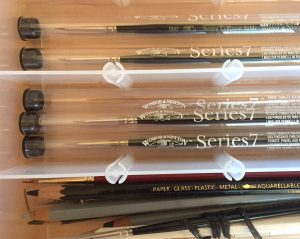
These are a few of my brushes.
I usually find myself using a 00 for most things, but a 000 also works very well. If you are working on a large area of all the same shade, then a 00 will hold more dye and you can work faster. If you’re in an area where you are constantly changing densities, a 000 is faster for that kind of work. I use a 0 for applying just distilled water if needed, but I never use it for dye. I know some people that use a 0 for spotting but I find I can control the amount of dye more easily with a smaller brush size, 00 or 000. To each his own. Get a selection of various sizes so you can find the one that works best for you.
This image shows the relative sizes of three different brushes. 000 at the top, 00  in the middle, and a 0 at the bottom, although the markings have worn off from use.